
What the Jungfrau Railway is
The Jungfrau Railway (Jungfraubahn in German) is the last leg of every rail journey to the Jungfraujoch. It carries passengers from Kleine Scheidegg to the Jungfraujoch: about 9 km of track that climbs roughly 1,400 m, most of it inside a 7.6 km tunnel cut through the Eiger and the Mönch.
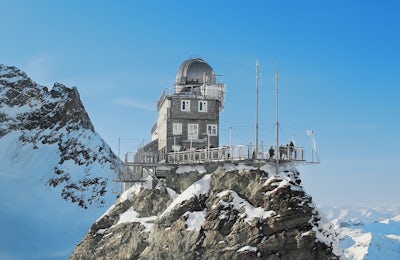
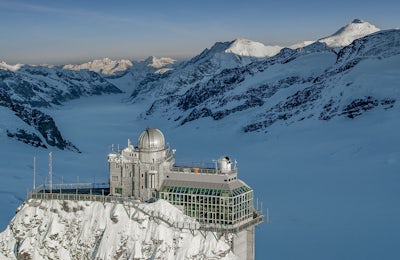
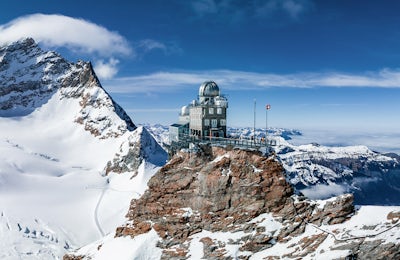
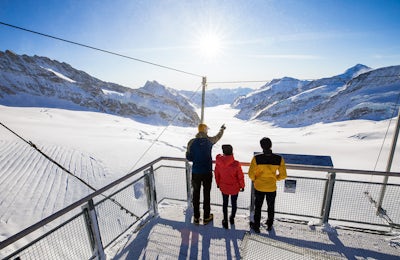
At the top, the station sits at 3,454 m. A lift takes you on to the Sphinx terrace at 3,571 m, which looks over the Aletsch Glacier, part of the Swiss Alps Jungfrau-Aletsch UNESCO World Heritage site, first inscribed in 2001.
You cannot board it in Interlaken. Every route first takes you to Kleine Scheidegg or, with the Eiger Express, to Eigergletscher, and you change there.
Route and stations
| Station | Altitude | What happens here |
|---|---|---|
| Kleine Scheidegg | 2,061 m | Start of the line. Trains from Grindelwald and from Lauterbrunnen via Wengen (Wengernalp Railway) arrive here; you change to the Jungfrau Railway. |
| Eigergletscher | 2,328 m | Top station of the Eiger Express from Grindelwald Terminal. Travellers on that route board the train here; about 28 minutes to the top. |
| Eismeer | about 3,160 m | A viewing stop of about five minutes inside the mountain. Jungfrau Railways notes that it cannot always be guaranteed. |
| Jungfraujoch | 3,454 m | Terminus. From here you walk on to the Sphinx lift, the Ice Palace and the rest of the Top of Europe circuit. |
Kleine Scheidegg to the Jungfraujoch takes about half an hour; Jungfrau Railways gives 25–35 minutes depending on the train. Eigerwand (2,865 m), opened in 1903, is a historic station and not a stop on today's journey.
Three ways up from Interlaken
All three routes start at Interlaken Ost and end on the same train. The difference is how you reach it. Journey times below are the official figures where Jungfrau Railways publishes one, otherwise taken from the timetable.
| Route | How it goes | Journey time |
|---|---|---|
| Via the Eiger Express | Train to Grindelwald Terminal → Eiger Express cable car (15 min) to Eigergletscher → Jungfrau Railway | About 1 h 30 min from Interlaken Ost; 45 min from Grindelwald Terminal |
| Via Grindelwald and Kleine Scheidegg | Train to Grindelwald → Wengernalp Railway to Kleine Scheidegg → Jungfrau Railway | 1 h 26 min from Grindelwald, plus the train from Interlaken Ost |
| Via Lauterbrunnen and Wengen | Berner Oberland Railway to Lauterbrunnen → Wengernalp Railway via Wengen to Kleine Scheidegg → Jungfrau Railway | About 2 hours from Interlaken Ost |
The Eiger Express route is the quickest. The two rail-only routes are slower but run past Wengen or Grindelwald and the Kleine Scheidegg pass, and they work as a different way down if your ticket allows it.
Maintenance closures in mid-November are normal, and single sections can be restricted for weeks (in 2026, Wengen–Kleine Scheidegg until early December). The official operating information shows what is running today.
How the train works
A 25 % gradient is far too steep for wheels on rails alone. The Jungfrau Railway is a metre-gauge (1,000 mm) rack railway using the Strub system: a toothed rack between the rails engages a cog on the train. Since 1951 the whole line has been rack-operated. Power comes from a 1,125 V three-phase AC supply.
Each railway on the way up was built separately, which is why you change trains:
| Line | Opened | Length | Gauge | Steepest |
|---|---|---|---|---|
| Berner Oberland Railway (BOB), Interlaken Ost – Lauterbrunnen / Grindelwald | 1890 | 23.69 km | 1,000 mm | 120 ‰ |
| Wengernalp Railway (WAB), Lauterbrunnen – Wengen – Kleine Scheidegg – Grindelwald | 1893 | 19.11 km | 800 mm | 250 ‰ |
| Jungfrau Railway (JB), Kleine Scheidegg – Jungfraujoch | 1912 | about 9 km | 1,000 mm | 250 ‰ |
How it was built
The railway was dug in stages, and each new station opened to visitors while the tunnel crews kept working above it.
- 27 July 1896: groundbreaking
- 19 September 1898: first section opens, Kleine Scheidegg to Eigergletscher
- 28 June 1903: Eigerwand station (2,865 m) opens
- 25 July 1905: Eismeer station opens
- 21 February 1912: the tunnel breaks through at the Jungfraujoch
- 1 August 1912: the first train reaches the Jungfraujoch
- 1951: the whole line becomes rack-operated
Thirty workers died during the construction.
Seat reservation
Jungfrau Railways strongly recommends a paid seat reservation on the Jungfrau Railway, at CHF 10 per person. According to the official FAQ it is mandatory from 1 May to 31 October 2027. The reservation ties you to a departure, so book it together with your ticket and plan the connections from Interlaken around it. Our price guide explains how it combines with each ticket.
Winter timetable
The train runs in winter too. In the winter timetable trains run every 30 minutes; the first arrival on the Jungfraujoch is around 09:10 and the last train down leaves around 16:45. These times come from the timetable, not from jungfrau.ch, and can change: check the timetable for your date and the operating information on the day. Before you go, also look at the Jungfraujoch weather and webcams.
Tickets for the Jungfrau Railway
You do not buy the Jungfrau Railway on its own. A Jungfraujoch ticket covers the whole route from your starting station, so the price depends on where you start, which way you go up and which pass you hold.
- Jungfraujoch prices: fares by starting point, children and seat reservations.
- Eiger Express: the cable car from Grindelwald Terminal that saves time on the way up.
- Good Morning ticket: 20 % off the full fare if you take the first trains of the day, May to October.
- Swiss Travel Pass: 25 % off the mountain ticket, and what the pass covers before Interlaken.
Official sources are listed at the end of this page. Last checked: November 2026.