
Cableways of the Jungfrau region: how to read the network
The Bernese Oberland around Grindelwald, Lauterbrunnen, and Interlaken is one of the densest mountain-transport clusters in the world. Modern 3S tricableways, classic reversible aerial trams, gondola loops, and historic rack railways overlap in ways that confuse first-time visitors—especially when two different companies operate adjacent valleys.
This page orients you by line, not by marketing brand names alone. Where a price table appears, treat it as a 2026 planning anchor from public materials; always confirm the live basket on jungfrau.ch before you pay. Children’s rules, pass combinations, and bike surcharges can change the headline adult cell.
If you already know you will ride heavily for several days, compare these singles against a Jungfrau Travel Pass and read the breakeven walkthrough on pass cost maths before you commit.
Eiger Express
Route: Grindelwald Terminal – Eigergletscher
Opened in 2020, the Eiger Express is the fastest public path from the Grindelwald valley floor to the upper saddle beneath the Eiger north face. In about fifteen minutes you clear roughly 1,368 vertical metres with a cabin designed for flow into the Jungfrau Railway toward the Jungfraujoch. The visual drama is frontal: the Mönch–Eiger wall fills the windscreen as you climb.
| Ticket | Adults | Children |
|---|---|---|
| One way | CHF 36 | CHF 18 |
| Return | CHF 54 | CHF 27 |
More about the Eiger Express →
Grindelwald–First gondola
Route: Grindelwald – First (2,168 m)
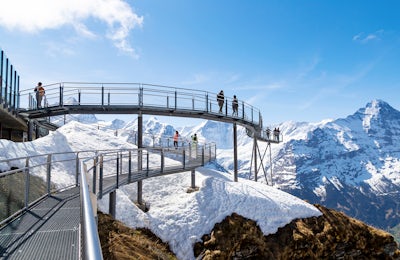
The First gondola is the workhorse of “active Grindelwald” days: First Cliff Walk, First Glider and Flyer activities, and the postcard hike to Bachalpsee. It is included on the Jungfrau Travel Pass map, which is why many four-day itineraries lean on First twice—once for adrenaline toys, once for photography if weather improves.
| Ticket | Adults | Children |
|---|---|---|
| Return | CHF 72 | CHF 36 |
Grindelwald–Männlichen gondola
Route: Grindelwald Terminal – Männlichen (2,343 m)
Männlichen is a panoramic shoulder with one of the cleanest sightlines toward Eiger, Mönch, and Jungfrau. The gentle panorama trail toward Kleine Scheidegg is a favourite for families who want altitude without committing to the summit price the same morning.
| Ticket | Adults | Children |
|---|---|---|
| Return | CHF 52 | CHF 26 |
Wengen–Männlichen aerial cableway
Route: Wengen – Männlichen (2,343 m)
The Wengen side offers a different silhouette of the same ridge—useful if you sleep car-free in Wengen and want a circular hike down toward Grindelwald or back toward Kleine Scheidegg. Timetables shrink outside peak hiking months; always check last descent before you walk downslope.
Harder Kulm funicular
Route: Interlaken – Harder Kulm (1,322 m)
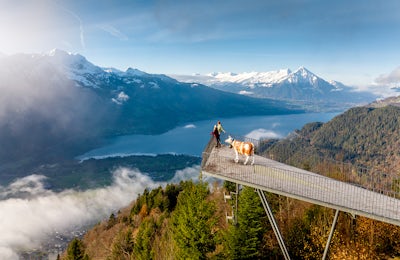
Interlaken’s “house mountain” frames both lakes in one telephoto sweep. Swiss Travel Pass holders often enjoy free travel here—double-check your pass generation and the current benefit list, because marketing PDFs age faster than steel rails.
| Ticket | Adults | Children |
|---|---|---|
| Return | CHF 34 | CHF 17 |
Lauterbrunnen–Grütschalp cableway
Route: Lauterbrunnen – Grütschalp
This short aerial link begins the classic climb toward Mürren. You continue by narrow-gauge mountain railway across the sunny terrace above the Lauterbrunnen cliff wall. Luggage and strollers are doable but still mean transfers—price comfort against time when you choose Wengen versus Mürren hotels.
Schilthorn cableway (LSMS)
Route: Stechelberg – Mürren – Schilthorn (2,970 m)
The Schilthorn is operated outside Jungfrau Railways’ corporate umbrella but belongs in any “cable day” conversation: revolving Piz Gloria restaurant, Bond heritage, and a summit view that competes with the Jungfraujoch for drama on clear days. Tickets do not interchange with Jungfrau summit products—budget it as its own line item.
If you will genuinely use Eiger Express, First, Männlichen, Harder Kulm, and Schynige Platte within the pass window, a Jungfrau Travel Pass often collapses mental accounting—even before you add boats. If you only ride twice, singles usually win; see the pass breakeven page for arithmetic instead of instinct.
Cogwheel classics that pair with cableways
Not every “mountain ride” is a gondola. Three rack systems anchor the cultural identity of the region:
Jungfrau Railway
Route: Kleine Scheidegg / Eigergletscher – Jungfraujoch (3,454 m)
The century-old tunnel railway is an attraction in its own right: midway stops at viewing windows inside the Eiger rock mass remind you that passengers were riding here before colour photography went mainstream.
Wengernalp Railway
Route: Lauterbrunnen / Grindelwald – Kleine Scheidegg
This long cog spine stitches car-free villages to the high saddle. It is photogenic, punctual, and—on busy ski Saturdays—still subject to capacity reality like any other mountain line.
Schynige Platte Railway
Route: Wilderswil – Schynige Platte (1,967 m)
Nostalgic wooden coaches and alpine botany make this a slow-food day compared with the Eiger Express. It is included on the Jungfrau Travel Pass map and pairs well with a lake swim in the afternoon heat.
Which lift for which goal?
| Goal | Suggested route | Approximate time |
|---|---|---|
| Jungfraujoch | Eiger Express + Jungfrau Railway | ~45 min from Grindelwald Terminal |
| Grindelwald–First | First gondola | ~25 min |
| Männlichen | Gondola from Grindelwald Terminal | ~20 min |
| Mürren | Lauterbrunnen cableway + mountain railway | ~25 min from Lauterbrunnen |
| Schilthorn | Schilthorn cableway from Stechelberg | ~30 min |
Times assume normal operations without wind holds. Add buffer on transfer days when you have international trains—the Bernese Oberland punishes optimistic connections.
Reading tickets: what “return” really means
Swiss mountain products often sell as same-day returns for leisure visitors, but conditions print in fine text. If you plan a lateral hike that exits a different valley, verify whether your ticket allows break-of-journey or whether you must buy a point-to-point fare suited to open jaws. Staff at major valley stations can print a mini-itinerary if you explain your walking exit—bring a map or offline GPX track to remove ambiguity.
Half-Fare Card holders should confirm whether each aerial segment discounts independently or bundles into a composite fare in the cart. The UI on third-party resellers does not always mirror jungfrau.ch line-for-line.
Seasonal personality of each line
Eiger Express: ski Saturdays move enormous pedestrian traffic; expect full cabins even when departure boards still claim punctuality. Weekday shoulder season can feel like a private aerial tram if you time the first public wave after locals commute.
First: summer afternoons stack paragliders, hikers, and families; morning ascents are calmer for photography. Thunderstorms build quickly behind warm fronts—watch lightning apps rather than guessing from blue sky overhead.
Männlichen: panorama trail popularity means descents toward Kleine Scheidegg can feel like a pedestrian motorway on sunny Sundays. Start early or accept slower walking speeds and pass courteously.
Harder Kulm: sunset departures sell romance and crowds simultaneously. If you want a quieter table, book the restaurant or arrive for the earliest supper sitting.
Mürren chain: storm cells sometimes strand tourists who mis-timed the last descent from the sunny cliff terrace. Always read last-carriage times at breakfast, not at 17:55.
Operational and comfort notes
Wind and ice shape aerial schedules more aggressively than urban metros. Morning fog in the valleys can lift by noon; conversely, innocent mid-morning cumulus can close ridges. Use official webcams rather than hope.
Step-free access varies by generation of station: Grindelwald Terminal is built for flow, while some older mountain railway platforms still have short stairs during maintenance detours. If you travel with reduced mobility, ask Jungfrau guest services for a station-by-station sheet rather than inferring from a brochure map.
Bikes: many gondolas allow bicycles on off-peak departures for a surcharge; rack railways may restrict dimensions. Confirm the specific operator message the evening before you pedal to a valley station.
Valley staging: where to sleep for which lifts
Grindelwald Terminal side: best for Eiger Express–first Jungfraujoch attempts and for First-heavy hiking programmes. Parking garages and bus bays concentrate here; it feels like a small alpine airport without jets.
Grindelwald village core: classic hotel fabric, bakery mornings, and older cogwheel access patterns. You may trade a few minutes of walking for atmosphere—worth it for guests who dislike sleeping above a bus interchange.
Wengen: car-free calm with Wengernalp and Männlichen aerial access. Excellent if your mental model is “ridge walks and Kleine Scheidegg” rather than “First every day”.
Lauterbrunnen floor: dramatic cliff walls and quick access toward Mürren and Schilthorn staging via Stechelberg buses. Rainy-week aesthetics suit photographers who love mood.
Interlaken: lake sports and Harder Kulm sunsets; longer transfers to high lifts but unbeatable for arrival-day acclimatisation walks.
How this page fits the rest of the English guide
Use cable cars as the physical layer, prices as the money layer, and Sphinx as the summit experience layer. Together they answer “how do I move?” and “what will it cost?” without pretending to be a live ticket office.